SEARCH INTENT — What Searches Really Mean?
If Journey Mapping explains how a visitor behaves inside your website, Search Intent explains the step they’re standing in before they arrive. Most founders believeIf SEO is a game of keywords and content volume. But underneath all rankings, Google is simply trying to understand one question:
What is this user trying to do right now?
Once you understand this question, SEO stops behaving like a mysterious algorithm and starts feeling like common sense.
SEARCH INTENT IS JUST JOURNEY MAPPING + KEYWORDS
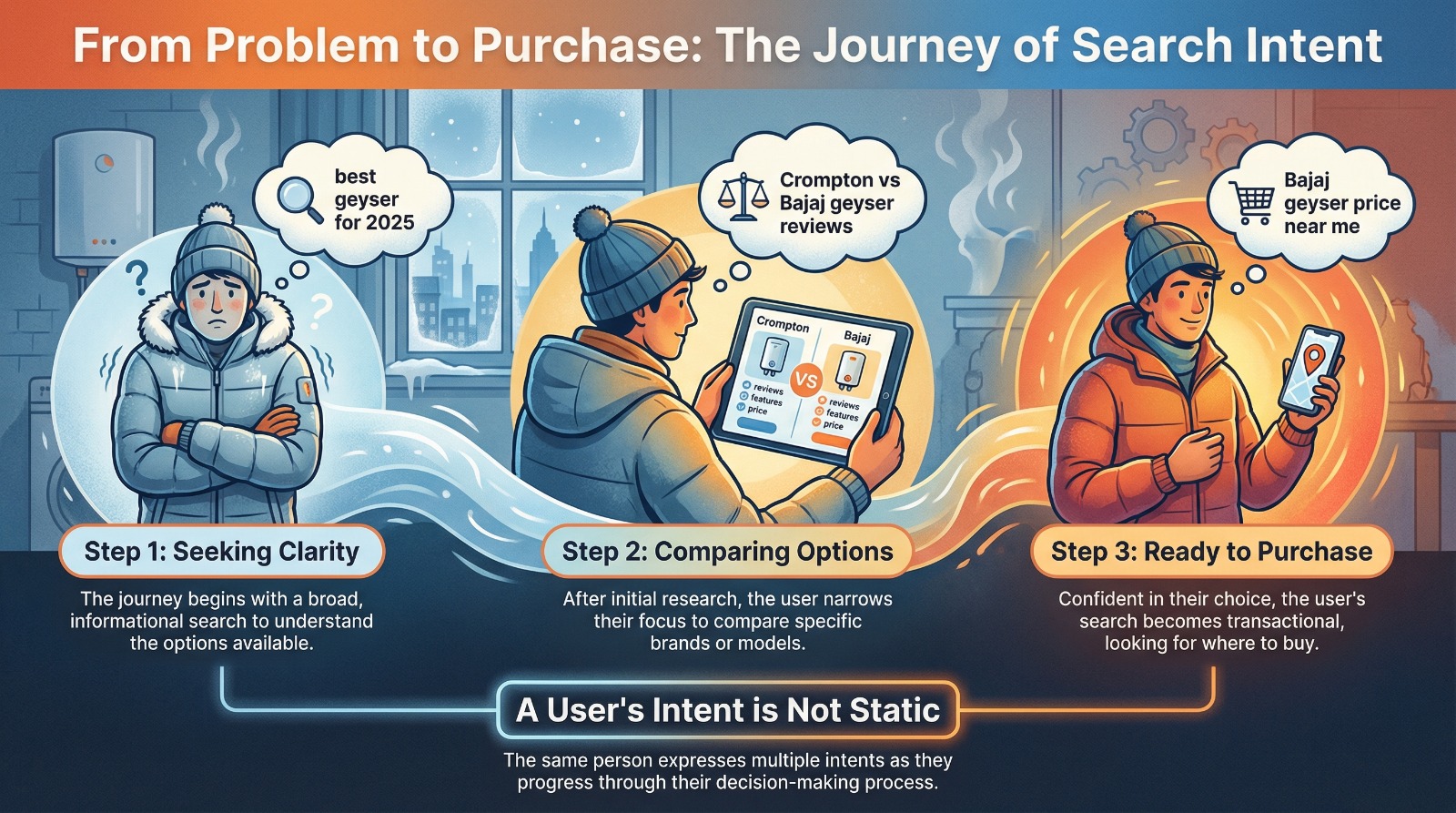
Let’s start with something familiar: Delhi winters and broken geysers — a universally Indian problem. When your geyser dies in January, you never start by searching “buy Bajaj 15L geyser now”. Your first instinct is to get clarity. You search for “best geyser for 2025”. Once clarity forms, you compare: “Crompton vs Bajaj geyser reviews”. Only when you are confident do you search for “Bajaj geyser price near me”. The intent progresses step by step. This is the core of Search Intent. The same person changes intent multiple times.
THE INTENT BEHIND EVERYDAY INDIAN SEARCHES
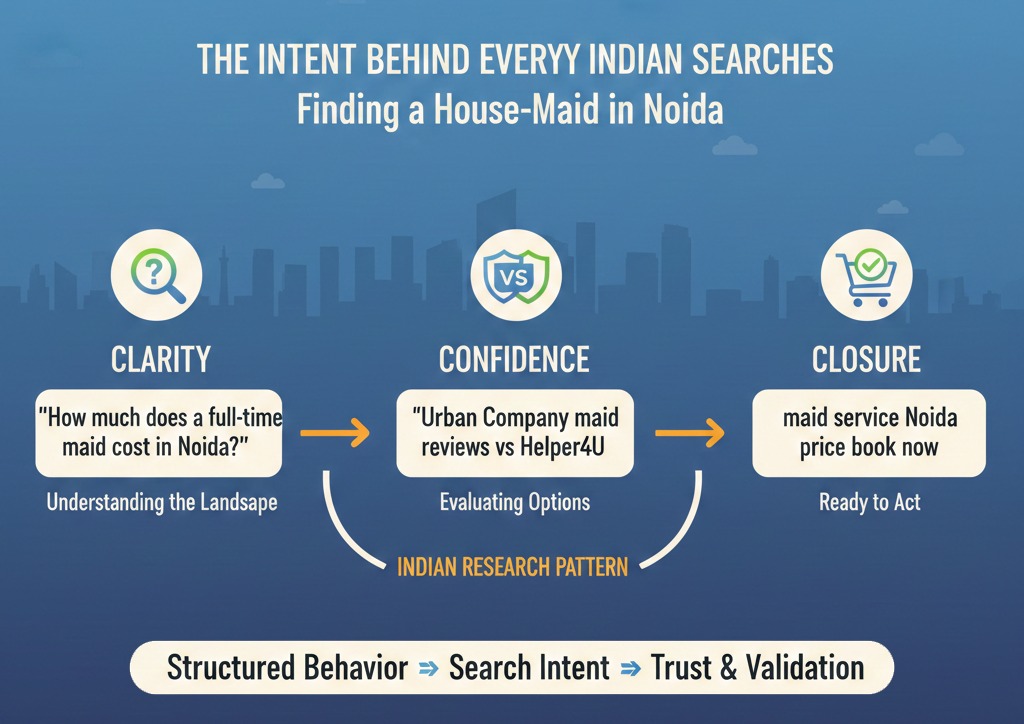
Consider another example: Finding a House-Maid in Noida.
A family begins with “How much does a full-time maid cost in Noida?” — they need clarity. They then move to “Urban Company maid reviews vs Helper4U” — they want confidence. Finally, they search “maid service Noida price book now” — they want closure. Indian behaviour is incredibly structured because we’re habitual researchers. Search Intent simply mirrors this research pattern.
Structured SEO: Why intent must connect to architecture
HOW TO USE SEARCH INTENT IN SEO
Search Intent is only complicated when examples are avoided. The truth is extremely simple: one intent should map to one page. (See how one-intent-one-page increased sales clarity for a D2C brand). A page that tries to educate, compare, and convert all at the same time creates noise — not clarity. Google doesn’t reward noise.
Search Intent optimised pages have purpose and boundaries.
An Understand page shouldn’t contain a pricing CTA.
A Compare page shouldn’t behave like a brochure.
A Decide page shouldn’t drown the user in storytelling.
The magic happens when each page performs only the job it was built for.
Here’s a free tool for you, Check your site’s Intent–Page Mismatch Score here.
If you’d like a quick 30-minute conversation to decode Search Intent for your website and identify mismatches hurting your rankings, feel free to
Book a clarity session- Link to the Book slot formHow People Buy
Structured SEO transforms marketing from a cost centre into an engine of measurable growth — one that compounds even when you’re not watching.
Related Read: Journey Mapping - What users do AFTER they land.
PCG DigiVerse helps organisations build behaviour-led website journeys that turn confusion into clarity — and turn every user visit into a predictable path toward conversion.